



Before all else, a note from our Founder & CEO
As global economic uncertainty intensifies, our second quarterly update explores how South Africa-focused listed property could see a reassessment in investor sentiment. In times like these, locally grounded assets may start to look more attractive. Senior Listed Property Analyst, Ntokozo Mkhize, weighs in on the resilience of the domestic property market. She highlights several key tailwinds contributing to its relative stability. Enjoy.

THE SOUTH AFRICAN LISTED PROPERTY SECTOR IN Q2 2025: POSITIVE MOMENTUM, GROWTH AND INVESTOR CONFIDENCE
In the second quarter of 2025, South Africa’s listed property market showed impressive momentum, particularly in May when the SA REIT sector delivered a 4.1% return. It outperformed both equities and bonds. Cumulative gains for the year reached 6.7% by the end of May, thanks to a robust April performance and a clear uptick in investor confidence. Market capitalisation broke through the R250 billion mark for the first time since January 2020, signalling renewed strength in the sector.
The investment environment continues to improve, with expectations of further interest rate cuts spurring optimism. Lower rates mean cheaper borrowing costs and higher potential income for investors, which makes property assets more attractive. Globally, about two-thirds of real estate markets have entered a “Buy” phase, suggesting a cyclical rebound. Central banks, including the Federal Reserve in the U.S. and the South African Reserve Bank, are either pausing interest rate hikes or beginning to cut rates, further easing funding pressures. In the UK, forecasts suggest a potential 100 basis-point reduction in 2025, amplifying the appeal of income-generating assets like listed property.
However, the global backdrop remains volatile. In June, President Trump unexpectedly doubled U.S. tariffs on imported steel and aluminium (excluding the UK), raising trade tensions and unsettling global markets. His unpredictable approach to tariffs added uncertainty and disrupted supply chains, leaving investors to reassess the economic and inflationary risks as the month unfolded.

South African stocks had a solid second quarter in 2025, with the FTSE/JSE All Share Index rising by about 5.3%. There was a brief dip in the middle of June, but the market quickly bounced back, closing the quarter at its highest levels in several months. This recovery signals that investor confidence in local equities has been reignited.
On May 29, the South African Reserve Bank lowered the repo rate by 25 basis points, bringing it down to 7.25%. This move was made in response to low inflation and a strengthening rand, with unanimous support from the Monetary Policy Committee. It was a clear message that the central bank sees room to support the economy without risking inflation. At the same time, the bank revised its economic growth forecast for 2025, reducing it from 1.7% to 1.2%. Although that’s a downgrade, it aligns with their efforts to make monetary policy more supportive.
Inflation stayed consistently low at 2.8% in both April and May, comfortably below the bank’s 3 to 6% target range. Given this calm inflation environment, the Reserve Bank is now exploring the idea of adjusting its inflation target altogether. It released modelling to support a possible shift to a tighter 3% goal, compared to the current midpoint target of 4.5%. However, any formal change would still need approval from the finance minister.
Below we provide a concise overview of developments in the second quarter of 2025, focusing on key economic trends, sectoral performance, and the outlook for the period ahead.
Asset Class Performance: Q2 2025 (1 April – 30 June 2025)
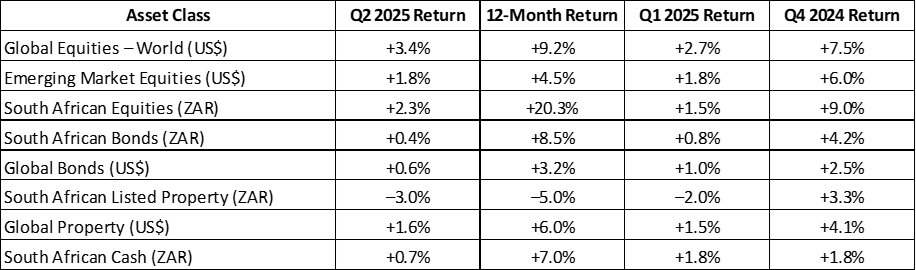
GLOBAL MACRO CONTEXT AND MARKET TRENDS
During the second quarter of 2025, the global economy faced a lot of uncertainty. This was largely caused by unpredictable U.S. trade decisions, new tariffs, and rising political tensions, especially in the Middle East. These issues made investors nervous and stirred up financial markets around the world. Due to these challenges, experts lowered their expectations for global economic growth. They now think it’ll grow only by about 2.3% to 2.4%, which is slower than previously hoped. While inflation eased overall, the new tariffs caused supply issues that led to higher consumer prices in the U.S. and parts of Asia.
China’s economy remained resilient in Q2 2025 with GDP annual growth around 5.1%, though momentum slowed moderately from Q1. The deceleration reflected tariff headwinds, soft consumption, and property sector strain, despite policy support helping to stabilize activity during the quarter. The MSCI China Index delivered a modest net return of approximately +2.0% in Q2 2025, reflecting soft equity appreciation and minimal dividend income, well below the broader emerging markets’ rally which was weighed down by trade uncertainty, property-sector weakness, and subdued domestic demand despite monetary support.
In terms of commodities, brent crude price during Q2 2025 fell sharply to approximately US $67.88 per barrel, down from about $75.73 in Q1, as OPEC+ eased production cuts and global supply conditions softened. The second quarter of 2025 marked a recovery phase for global property markets, especially in the UK, Europe, and select emerging markets. With interest rate cuts or stability across key central banks, income-seeking investors returned to REITs and real assets. While risks persist, especially in Chinese CRE and U.S. office segments, fundamentals in logistics, retail, and residential properties underpinned the global rebound.
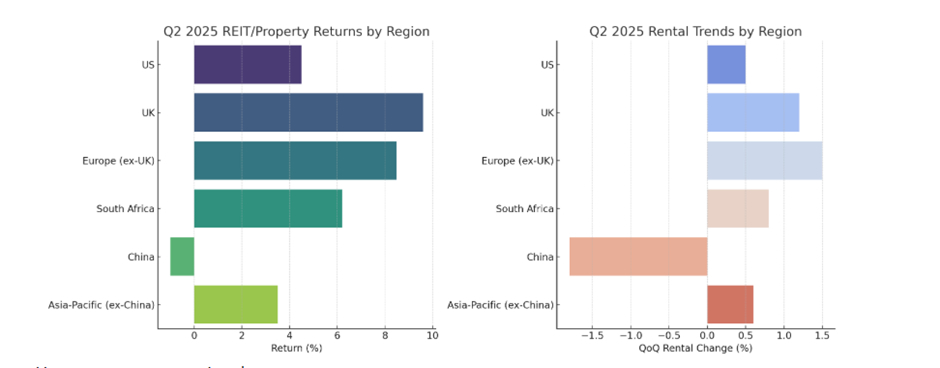
PROPERTY SECTOR – PERFORMANCE AND INSIGHTS

South Africa’s economy is showing signs of bouncing back. In June, the South African Reserve Bank (SARB) lowered interest rates slightly, 0.25%, for the first time since 2020. This helped lift the mood among investors. As a result, certain parts of the market started to improve.
Shares in property companies did well, outperforming regular stocks. That’s because lower interest rates make property more appealing as they tend to offer better income returns, especially when retail spaces are steady and profitable. Bonds (government debt) also saw a small improvement, and the Rand (South Africa’s currency) strengthened a bit thanks to clearer government policies and investment strategies.
The country’s inflation is now under control and sitting comfortably within the Reserve Bank’s target range. Political uncertainty dropped following elections, and progress with the national power grid helped boost investor confidence. This led to more foreign investment, especially in South African bonds and property.
One of the biggest winners was the property sector. It delivered a solid 10.8% return for investors over the quarter, better than both equity stocks (up 10.2%) and bonds (up 5.9%). That strong showing came from a mix of rising property values and steady rental income. It’s a sign that South African property is recovering and looking attractive again, especially with interest rates easing.
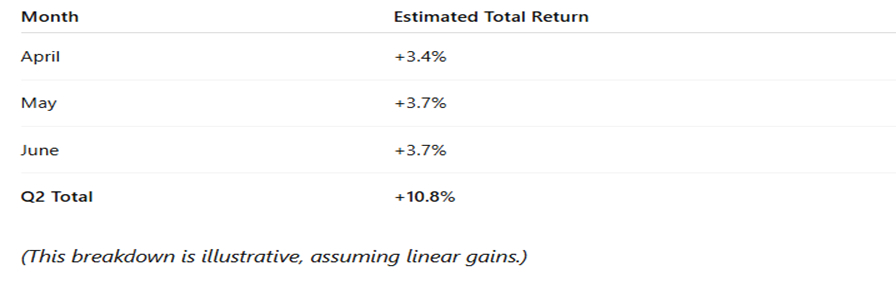
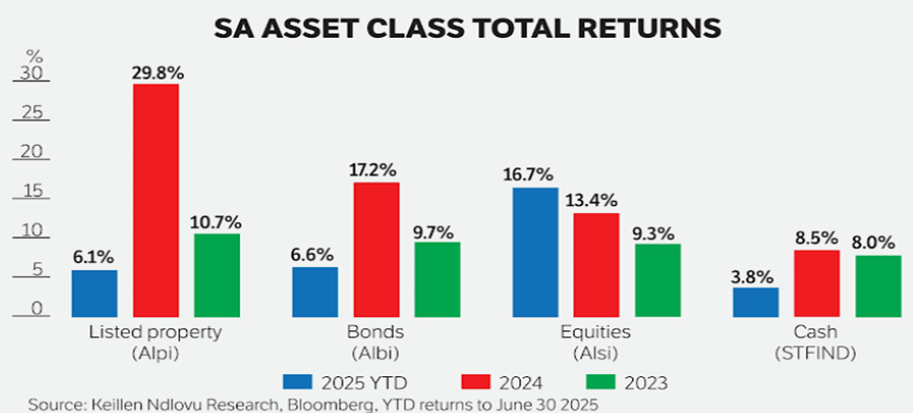
The SA direct property sector showed uneven recovery in Q2 2025, with retail and industrial assets outperforming, while offices remained weak. Easing rates, improved leasing momentum, and demand for essential retail/logistics space were key tailwinds.
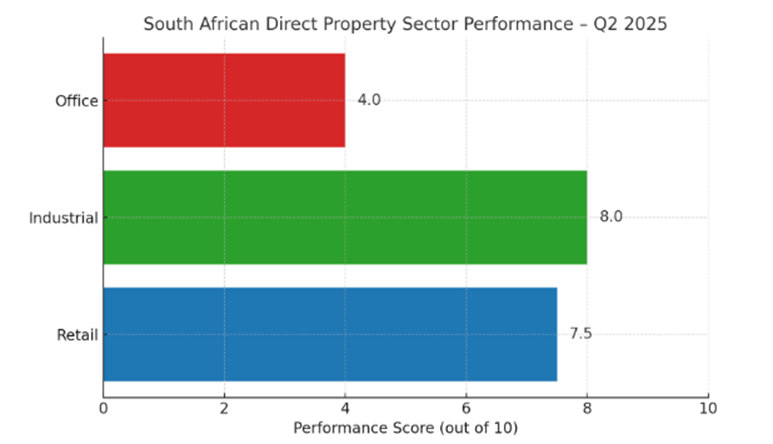
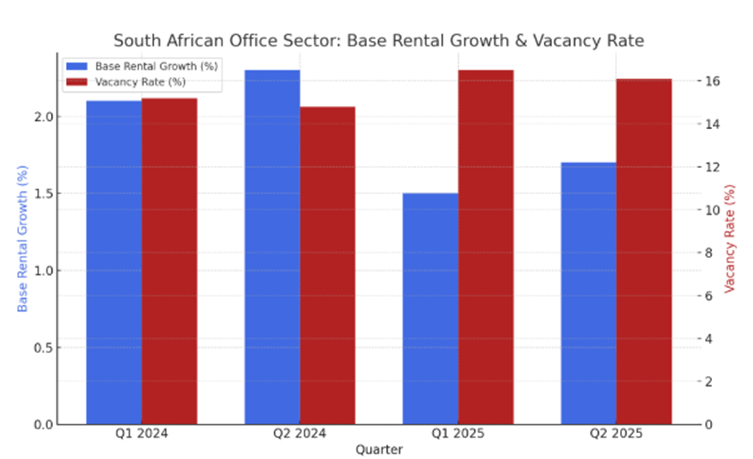
South Africa’s property market showed mixed results in mid-2025. Office buildings, especially those in central business districts, were still struggling. Their values dropped, and landlords had to offer long rent-free periods or cover tenant costs just to keep spaces occupied. Vacancy rates were high, with more than 15% of offices sitting empty.
In contrast, retail and industrial properties held steady. Shops in busy areas, like convenience centres and township malls, did well, thanks to regular foot traffic and essential services like grocery stores and pharmacies. Industrial buildings, especially those used for storage and logistics near ports and highways (like in Gauteng and KwaZulu-Natal), were in high demand. This was driven by growth in online shopping and fast-moving consumer goods.
Properties offered attractive income returns of between 8.5% and 10%, which beat the returns from just holding cash or bonds. Investors were especially interested in buildings with good energy efficiency, backup power solutions, and strong locations. Their focus shifted to high-quality buildings with multiple tenants and reliable leases.
Overall, while offices remained the weakest link, retail and industrial sectors showed solid performance and attracted more investor interest.
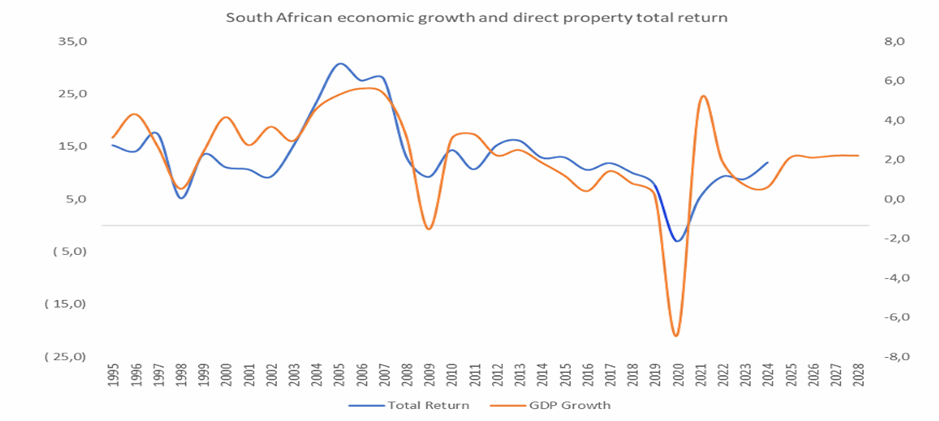
RETAIL SECTOR: REBOUNDED ON STRONG FOOT TRAFFIC & RENTS
In the second quarter of 2025, South Africa’s retail property sector held up favourably well. The strong performance came mostly from shopping centres that have grocery stores as anchor tenants which were places people visit regularly for essentials. These kinds of properties continued attracting shoppers with consistent foot traffic and steady consumer spending.
Retail landlords made smart upgrades to their properties, like adding solar panels and improving store layouts, which helped keep them attractive to both tenants and investors. With online shopping growing rapidly, physical retail spaces had to evolve, so the most successful ones started focusing on community-based, mixed-use centres that offer more than just shopping.
Rental income improved. Shops were doing better in terms of sales, so they could afford slightly higher rent and this was the first time in over three years that rent prices improved, even if by 0.4%. Vacancies stayed low, meaning most spaces were occupied, especially for big property groups like Growthpoint and Redefine Properties. Grocery stores and other essential retailers drove most of the foot traffic, helping the retail sector stay strong.
Part of this strength came from better consumer confidence. People had more money to spend thanks to lower inflation, more household income, and changes in the retirement system (Two Pot) that gave them more access to savings.
All these factors boosted the earnings and values of retail property portfolios. Property companies kept reshaping their spaces to match changing needs. Also prioritizing green buildings, convenient layouts, and a better mix of stores. Increasingly, Real Estate Investment Trusts are turning traditional malls into experience-based destinations that combine retail with lifestyle services to stay competitive with online shopping.
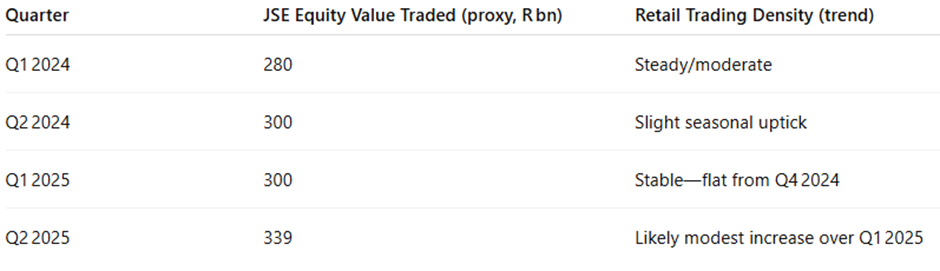
INDUSTRIAL SECTOR: DRIVEN BY MANUFACTURING GAINS DESPITE INFRASTRUCTURE CHALLENGES
South Africa’s manufacturing sector bounced back a little in May 2025, producing 0.5% more than it did a year earlier and growing 2% compared to April (which had taken a big hit, dropping 6.4%). Things are looking slightly better, but it’s far from a full recovery.
Business confidence in manufacturing is still low. A key indicator called the Purchasing Managers’ Index (PMI) shows how optimistic manufacturers are. If it’s above 50, it means things are growing; below 50 means they’re shrinking. May’s PMI was 43.1, which means manufacturing has been shrinking for seven months in a row.
Even though companies got more new orders, actual production remained weak. Another PMI from S&P Global, which looks at private businesses across sectors (not just manufacturing), showed almost no growth at barely above 50 in May.
In short, there are some signs of life, but manufacturers and private businesses are still struggling to gain momentum.
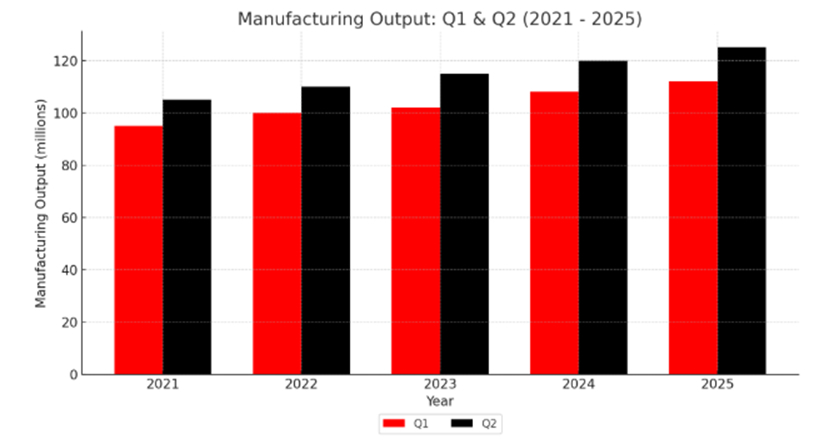
In this second quarter of 2025, South African businesses were feeling nervous. Confidence dropped to its lowest point in nearly four years, falling to 40 out of 100, which is a signal that many companies are cautious about the future. The reasons behind this dip are quite serious: poor rail and port services (especially from Transnet), expensive electricity, and confusion around U.S. trade tariffs all made running businesses harder. For example, the steel company ArcelorMittal said it might shut down its long-steel factories unless these problems are fixed soon.
South Africa’s local steel industry is really struggling. It’s so expensive and difficult to produce locally that over 35% of the steel being used now comes from overseas instead. Challenges like weak local demand, high energy prices, slow logistics, and tough competition have pushed South African factories into a corner.
Despite all these problems, there’s a glimmer of hope. Manufacturing output started climbing a little, and confidence among industrial businesses nudged upward and still fragile, but better than earlier this year. One bright spot is the industrial property market, which is growing thanks to the boom in online shopping and changes in global supply chains. Areas like Waterfall, Longmeadow, Cornubia, and Umgeni Business Park are doing especially well, with very few empty buildings and rents going up.
Therefore, while many companies are still hesitant due to infrastructure issues and global trade uncertainty, certain parts of the economy, especially logistics and industrial real estate are showing resilience. This targeted investment approach signals rising optimism in the logistics property sector. The market’s vitality is highlighted by strong occupancy rates and ongoing rental growth, as more businesses prioritize the expansion of their warehousing and distribution networks.
OFFICE SECTOR: SLOW RECOVERY AMID SHIFTING WORK PATTERNS
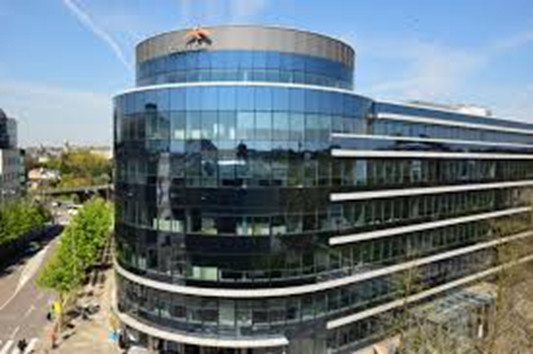
South Africa’s office property market is slowly bouncing back from the chaos caused by the pandemic and oversupply. More companies are using their office space again, especially in popular areas like Sandton, Cape Town, and Rosebank. There are still a lot of empty offices, but vacancy rates seem to be levelling out. Rents haven’t changed much, but they have nudged slightly higher in key locations because there are not many new buildings coming up and people still want good-quality space.
Many businesses now mix working from home with coming into the office (the hybrid model), they’re looking for smaller, flexible offices that are well located and equipped with modern tech, safety features, and amenities. Sectors like finance, tech, and law are leading the charge in renting out space.
Not many new office buildings are being built. Developers are cautious and funding is tight, so the focus has shifted to fixing up and modernizing older buildings to meet new demands, especially with sustainability in mind.
Investors are starting to show interest again, especially in top-grade office buildings that have reliable tenants. Returns are still relatively good compared to other types of property, though the profit margin on high-end buildings is starting to shrink slightly.
Challenges like inflation and slow economic growth are still putting pressure on the office sector. Almost 1 in 5 office property deals are now looking to turn old office space into apartments or mixed-use buildings, with Johannesburg leading the way.
Looking ahead, the office sector is expected to keep improving bit by bit through the rest of 2025, helped by businesses merging operations, adopting smarter workspace strategies, and investors returning to quality buildings.
The bar graph below is comparing South African office sector base rental growth and vacancy rates across Q1 & Q2 of 2024 and 2025.
OUTLOOK AND STRATEGIC IMPLICATIONS FOR THE LISTED PROPERTY SECTOR
South Africa’s listed property market (basically, property companies whose shares are traded publicly) showed some encouraging signs in the second quarter of 2025. The worst challenges from the pandemic and high interest rates might finally be fading, which is giving investors a bit more hope.
Retail and industrial properties are doing well, which helped boost confidence across the sector. Companies are earning more steadily, showing they have become better at handling tough conditions and are slowly bouncing back.
However, while things are looking better, it’s still not smooth sailing. For property companies to keep improving and give shareholders good returns, they need to be smart about how they manage their money, refine their portfolios (meaning keep the good properties and dispose of non-core, low-performing assets), and carefully explore investment opportunities outside of South Africa. Therefore, cautious optimism is the mood, however it will take clever strategy and discipline to keep that momentum going.
In June 2025, the macro environment is turning supportive for listed property, with stabilising valuations and easing rates. However, outcomes vary significantly by region and asset class. Due diligence is essential and favour sectors with strong structural demand (e.g., data centres, residential, logistics, healthcare), and regions showing stabilization in funding and fundamentals. Meanwhile, watch out for policy-driven headwinds, such as urban rental caps or persistent oversupply.
We ask you to be safe, and feel free to contact us with any questions. We appreciate your support and confidence in us, in being able to manage and grow your wealth.
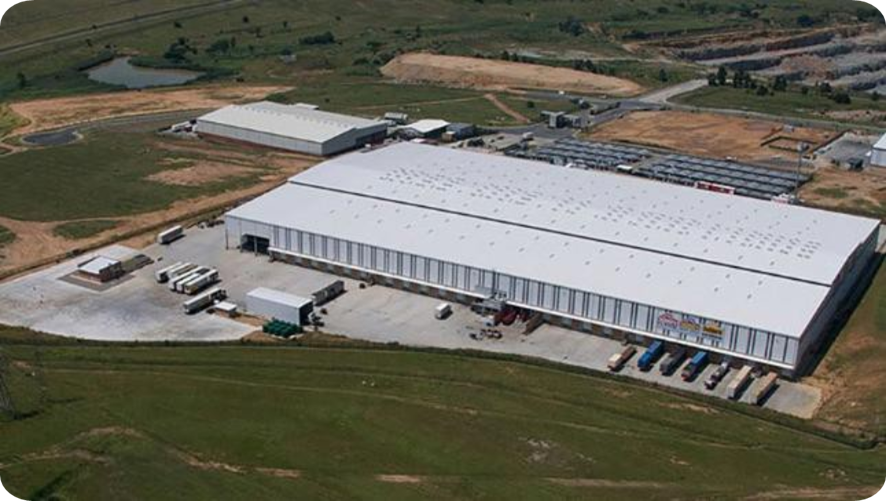
This targeted investment approach signals rising optimism in the logistics property sector. The market’s vitality is highlighted by strong occupancy rates and ongoing rental growth, as more businesses prioritize the expansion of their warehousing and distribution networks.
OUTLOOK AND STRATEGIC IMPLICATIONS FOR THE LISTED PROPERTY SECTOR
South Africa’s listed property sector is in a good position to benefit from positive local and global trends in the second quarter. The South African Reserve Bank’s carefully considered approach to easing interest rates, along with a stronger rand, supports continued investor interest in property assets. The significant reduction in loadshedding and improving vacancies across the board is expected to bear positive effects on listed property stocks.
Stable inflation could drive more demand for income-generating assets like property stocks and bonds. Although these developments are encouraging, the property sector continues to contend with challenges such as infrastructure constraints, elevated unemployment, and increasing energy expenses.
In short, the first quarter and rest of 2025 has reflected both challenges and even better opportunities. Going forward, staying adaptable and focusing on growth areas will be the key to maintaining this positive trend and delivering value for investors, backed by strong investor support and an improving economic environment. Listed property is still trading at substantial discounts to Net Asset Value (NAV), and over time, prices should catch up to the true intrinsic value of the underlying properties.
We ask you to be safe, and feel free to contact us with any questions. We appreciate your support and confidence in us, in being able to manage and grow your wealth.

Ntokozo Mkhize – Senior Listed Property Analyst
Ntokozo is a Senior Listed Property Analyst with strong expertise in listed property, valuation, and asset management. She holds a BCom (Finance) and Honours in Quantity Surveying from Wits, an MSc in Real Estate from UP, and RE5 certification.
She began her career at Jones Lang LaSalle in Capital Markets, later specialising in valuations for major REIT clients across Sub-Saharan Africa. Ntokozo was Director and Lead Valuer at Strata Properties, then moved into listed property research at Afrifocus, followed by roles at Meago Asset Management and the Public Investment Corporation.